Thursday, April 23, 2015

That’s not how you use that!

gas1
We often have to ride that fine line between being practical and looking somewhat authentic.  One of the jokes I make when someone dismisses some of our equipment. (We are performers first and only in a limited capacity reenactors) my response is 
“Historically if they could have used it, they would have!” and we have a good laugh about it. That’s why we have tapestry covered folding chairs, bungie cords and other items. But one has to be inventive about hauling around equipment and storage so I’m sharing some of the ways we do that or-
 How a troupe has used perfectly ordinary items for a nonintended use

sword_rackTool Rack-This is a Rubbermaid tool rack. It collapses down into two bases and some short plastic legs and it fits flat in the car. If you’ve packed up a car for an event, one can appreciate a device that anyone can manhandle out of the car and can sit in the boot of most SUVs. We have two troupe-colored covers fastened with elastic and a safety pin. The rack is held in place by the very bungies that kept it a unit. It’s a terrible tool rack because it is HARD to take tools in and out but a GREAT sword rack because handsy people can’t just grab things and it is always a good idea to move a sword, slowly and carefully within the confines of a tent.
Car roof webbing: This turned out to be too elastic for most of our rooftop needs but when even the sword rack takes up too much room it makes a great hanging web for storing those same swords. One of the limitations is that it does not have the same capacity as the rack but if you have few people but need more real estate inside the tent-it’s ideal. And it takes up even less room than the tool rack. Available at most automotive stores
Hockey bags-Over the years we’ve tried a number of different sword bags. We use gun cases for our more expensive swords. (Aside, did you know that at certain southern airports no one blinks at a gun case but tell them that you are checking in a sword and they freak out? Just sharing that information so you are prepared) But frankly, the gun cases take space and so we have found the most tough and resilient bags are hockey bags. They are built to hold skates with blades, meant to be manhandled and some of the larger ones come with wheels. Golf Bags are also a good all-around choice for a number of items-we use them for tent parts, sword bags and general equipment. They are easily available and inexpensive so can tide you over until you can invest in something higher-end. We generally buy at Dick’s Sporting Goods.
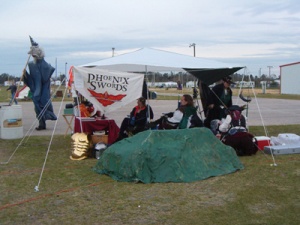
Back in the early days...our current tent is much nicer
popup
Pop-ups and poles-we used popups for years.  I honestly thing these are the heart of all small renfaires. The bigger festivals can afford to be fussy but this is the town that appears overnight  so that you can have a renfaire.  Also some folks have limited hands and mobility so this is much easier than a canvas and pole set-up which generally takes a minimum of three-to-four people. We love having our tent but when doing one-day festivals, or when it rains,  I miss having a popup. And you can really make them zing with covers and accents and in some cases, I think they add a certain insouciance that reminds stuffy faires of their roots. Some folks have cover designs online and some folks sell them.  We used to buy our tents at Dicks (see above) or there are good sales to be had in the winter at Elite Deals. And if you can’t afford sides you can grab inexpensive tapestries (see below)
Organizer bits-our favorite is the hanging shoe rack which is perfect for all those faire gifts, wallets,  glasses etc. and did you notice that it packs flat?  
tapestries
Bedspreads/tapestries/Curtains –these are great for covering gear, coolers, setting up change areas and dealing with water control.  We pack a bag of nothing but these to bring with us. I generally but from Indian Bedspreads but if you are inventive and crafty you can do canvas floor cloths as sides (google will bring up a host of DIY sites)
The last item I have on here is not authentic but such a great windfall that I have to share. We use an inflatable cooler  for keeping water and other  items corralled. The Inflatable Pirate Chest.  it’s cheap, it’s ugly and it is hard to blow up but it does the job and packs into a tiny bag. We didn’t have high hopes but it has survived two years with us.
Two of our members-Valkyrie and Monica are amazing at coming up with new ideas for making us light, mobile and efficient (several of these are their brainchild) And I am sure that many of you out there are coming up with some great stuff. So feel free to share in comments and I hope you found this useful. With any luck, we’ll have found a NEW batch of artifacts in a few years and will be revising this blog post!

Thursday, February 26, 2015

Doing manual research-right up there with paint drying

lian
With spring coming (eventually) I look forward to swinging  around swords and fire without so much hazard and clothing. But winter does lend itself to sitting down, reading manuals and doing some interpretation and scholarship. This generally leads to some peer review, some plays from history and if we’re lucky, a shared class and a new demonstration for the historical show.
Earlier, I’d become sick of driving 30+ miles each way for a group that meets in Cambridge, MA at MIT. It’s a good group but it was wearing on me. I asked “Why can’t we have a group that meets nearby? (and if you’ve driven in MA, you know why we are called M*SSholes) So we started Worcester Historical Oral Martial Practitioner’s Study (yes, that spells WHOMPS) It’s a few friends, Fenix and me in various backyards and living rooms going through facsimiles and translations. (Outrageous and non-period correct costumes optional)
liancour
Recently someone made a general inquiry and I told her 
“It mostly takes enthusiastic people, some source material and a living room with a high ceiling”
Really and truly that is your primordial ooze of historical European martial arts.
cookies

I also lure people with cookies

Here’s how we did it-we picked a manual  from here:
http://www.umass.edu/renaissance/lord/collection.html
Then we looked at some online translations and did our best to kluge through and make sense of it all. This involved calling in favors with people who spoke and wrote French,  asking some folks familiar with smallsword and taking our best guess.
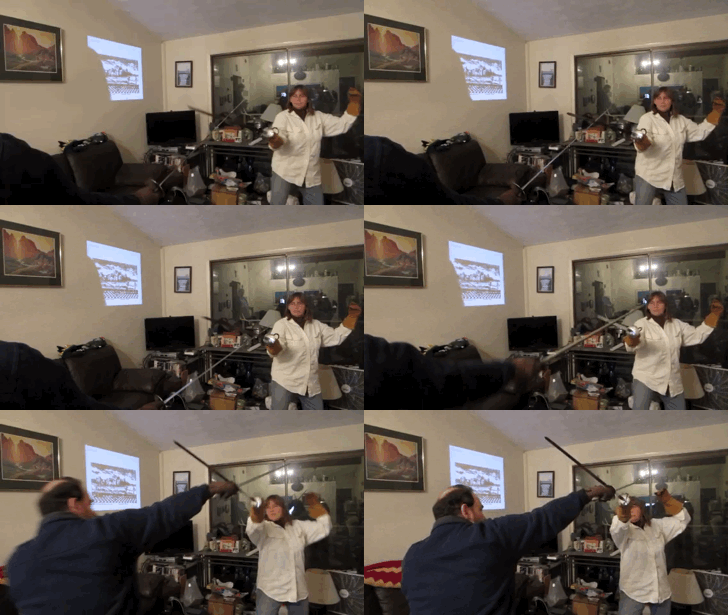
From there, we did approximately 1-2 sections per session. This involved having the English, our friend’s notes from our sessions, a projected image and an out-loud reader. Ideally you’d have a minimum of three people. We are fortunate to have four so we can swap out bodies, ideas and readers.   I tease our “bodies” and call them “Western Martial Arts Barbie” –that is, the outside observers position them, watch the maneuvers and critique. If you have a thin skin, this part will go poorly for you.  And if you have bias regarding another martial arts form-it will show up here. The difficult part is following the manual and not throwing in what you feel. And if you present the material that way to others-prepare to take the heat. I have been at a number of events where an interpretation has been presented and the speaker was stunned when the material was  skinned, gutted and held over an open flame (figuratively) If you try to cite your material and can’t find the relevant piece of reference, then it’s not really using the source material, it’s just making stuff up. And there are plenty of people with internet-bought blades slicing milk jugs and posting it on YouTube, thank you.
Prac-b
But you need people who are good at physical interpretation to balance your scholars. Because many treatises are fairly obscure and vague, sometimes there will be a position shown, a description and a WTH finish with no explanation. Bridging that gap is where the understanding of bodies, blades and geometry comes into play. I know a couple of people with a fantastic grasp of this-and they are still often wrong on the first go around.  Sometimes you will not come to an agreement within the group and you have to agree to move on and revisit it another day. No one gets it on the first try. Sadly we can’t reanimate these sword masters and ask what it was they *really* meant, we can only do our best guess with what they have left us. And there are similarities-in all martial arts-bodies move in limited ways, but we have to make sure it is physics, not slipping in some other form. An analogy might be using frog DNA to create dinosaurs, and we all know how that turned out….
peer
Reproducible results is one of the tricky points. This is my strength-I am the one with the dumb look on my face who says
“I don’t get it.” And I am willing to do it over, and over and over, and over until it is clear to me. And very often watching me struggle with something will illuminate that it is just a bad idea. It’s a gift, I know. And I might need someone to say that “It’s like George Silver” or a similar “maneuver in Swetnam” to get it. And there is nothing like teaching it to others to blow holes in all these nice interpretations and theories. Which brings me to;
Peer review, a key part to making sure you have done it correctly. I am not saying that more advanced sword users are always right-in fact, it’s good to question them and their opinions. Like you, they have to be ready to back the horse they rode in on and cite sources  and show and tell. “Because I said so” only works with your parents, not with your peers. If your work can’t stand this scrutiny, then it isn’t good work. I’m not saying that it is not discouraging or that you have to take what others say as gospel, but it IS good to take an additional look at your work. Sometimes we are too attached, or too close to our interpretation to see its flaws. A practitioner I respect very much was asked about a change he made in some teaching material and he had to admit he’d thrown some 19th century boxing techniques into the class, and had to admit that then the play was not a direct interpretation and should not be represented as part of the original material. Everything was all better over beer.
One of my favorite parts of continued work with weapons manuals-beer (after sword work) and camaraderie. Like any accomplishment, when you receive kudos for it, it’s great to share those accolades because in the wider world, that will not be forthcoming.  But when others in your sword community admire solid work, that makes it worthwhile. Different weapons will have different distances, stances, techniques and speeds. One will not use a poll arm like a dagger or a longsword like a cudgel (usually.) It can be maddening to see individuals dismissing the differences. The whole “to a man with a hammer, everything looks like a nail,” people. They make me a little crazy and it’s disrespectful.  So if you are someone at a renfaire and you make fun of people who have done more research  and then quote Wikipedia at me-in my mind I am sending you to a special hell. And other uncharitable thoughts.  But the bright side was that a German manuals scholar recognized our work at a faire-he rocked our world AND he wanted us to clarify the manual year. We are still talking about that to this day. So it’s not a big segment of the population but some people can appreciate and recognize flavors of swordplay.
The last thing I have to say about this is that you don’t have to be a snob about it. I will *gladly* and *gently* talk about swords with anyone who wants to discuss them. Manual interpretation is not sport fencing, it is not sparring (although information can cross those borders) and it’s not SCA fighting. It is its own creature and we are all better off discussing it in context. I would love to bring more people, regardless of physical skill into more historical research but it is not for everyone. It’s time consuming, problematic and riddled with as many alpha personalities as any other interest.  And it’s not for us to judge how it is used. A number of our stricter friends joke with us about translating it into performance pieces-but adding an entertainment element gets it to a wider audience. One member became the dreadnought of his Live Action Role-Playing group using a historical ward he learned with us-so you never know where the information will lead or how it will play out in the big picture.  

But if it sounds like something you’d want to do-here are some links (not exhaustive, just some suggested)
Membership gives access to manuals
http://www.ahfi.org/
Finding interested parties locally: (free to join)
http://www.swordforum.com/forums/forum.php
Getting Equipment
http://casiberia.com/
http://www.darkwoodarmory.com/
Or, as always please feel free to contact me-phoenixswords@gmail.com

Friday, February 13, 2015

A snapshot of my (general) individual experiences at renaissance faires

V_fire_14
One of the first experiences I had at a faire nearly put me off them completely. But I’m a born mistake maker-you know the person who has to do it twice to make sure of it. And in many cases that has saved me from making a hasty decision I may have regretted. Last entry I talked about non-renfaire entertainments with a “medieval” flavor. They are varied and wide just as being in a renaissance faire can be a buffet of what we take in for ourselves. So it really torques me when people explain how it is that I am expected to enjoy and or participate in a renaissance faire. It really goes right up my proverbial…nose.
Going as a patron-anything goes because one PAID  TO BE THERE.
When you are part of the ambiance,  having fun is not the number one priority-it can be a high one but you are paid to do a job (even if it is comp tickets) So I have been thinking about the experiences that I  personally enjoy.
I am a strange person who enjoys the setup as much as the show-fortunately we have others like that as well. Our group basically travels like a field trip-they get dressed, pack a lunch and expect a tour guide with written directions. If that’s what you want, that’s what you get- it leaves more head space for a performance, but I can’t go on comfortably without lists, discussion and touching everything.
Doing a good job-when we engage and it goes well that really warms me up inside. It means weeks and years of hard work have dragged our sorry butts here and we have earned a laurel crown that we get to wear until the next show. And it’s an accomplishment, it looks easy to be an entertainer but especially here in the Northeast, there is a certain cynical element that one needs to cannon-blast through to reach the audience.  We have to tone some things down when we travel to other parts of the country (that’s another blog entry) but when you have built a show brick by brick and it stands, there is nothing like it.
Being in the moment.  It’s funny to see how different this is for each different performer. For me it’s getting on-site and sitting down after setting up the tent, the moment before I have to start practicing our first bit for the day. It is especially satisfying if I get to sit in my own chair, but barring that, sometimes it’s just sitting on the grass or a cloak and taking in everything around me. And then it is listening to how a sword sounds or getting a sense of the performance space.  A habit I have is “walking the plot” or getting a sense of how big the stage is, how weapons fall in a disarm, where there may be holes in the ground or red ants, or a loose rope stanchion. Knowing it helps work in or with it. The performance itself passes in a blur so I rely on cameras, friends or other performers to tell me how it went. I don’t have a lot of mental capacity onstage and so it’s my game face and the task at hand. And being in the space is part of the greater faire as well. My eyesight isn’t the best at distance and I can’t wear contacts  so I rely on some of these same things to procure water, find a bathroom or just chat with visitors to the faire. I have what we jokingly call “retail face”  because no matter where I go, people expect me to know where items live, the location of first aid and the bathrooms.
There is the bonding element that is important. My devoted percentage to this seems to be smaller than that of most people. I’m fairly binary-can I get through this with you or not?  Sometimes the answer is “just through the performance.”  This is something of a lifesaver because I don’t generally need the approval, desire to be liked or friendship of another performer, this allows me to work with the ‘tough cases.’   Often we’ll have that “bee in a bonnet” at a job and it’s my duty to close my fist around it and take the sting for the team. My partner does this as well, we tag-team often. When it’s positive I really enjoy it. I may not need it to be as salacious, raucous or epic as everyone else, but I still enjoy it. And I like hearing how it went from my fellow performers-the retelling is part of the experience as well.
Faire hangover-I think this a different experience for everyone. My “day job” is at a conservative workplace with high politeness standards and indoor voices. I enjoy it very much. But when the time comes for doing performance I have to turn up the decibels,  be more outgoing and put on my arse-kicking boots. (I fact have to do this at practice every weekend so *shrug*) But without the filters, profanity limiters and hijinks ensuing, it can be hard to squeeze that genie back into the box. Fortunately for me, one of the bigger shows falls at a time where I have some transition. When I don’t have that, I’ve seen the reaction by my other set of employees and it’s like getting a face full of megaphone. But the two worlds are very different experiences and sometimes it’s hard not to laugh when placed back-to-back to one another.  I feel blessed to have both available.
If you asked many other performers it’s another set of the quiet and loud moments in different amounts, like a recipe or a sound check-tweaked to your personal needs and outputs. It’s not one thing to all people. So while I tell faire participants to get their friends involved, I do so with this caution-let their experience be their own and compliment yours, not clone it.

Thursday, February 5, 2015

One of these things is not like the others-observations on "Medieval-style" shows

blog_knight blogwench
We are a bit spoiled, we cater to renaissance faires and in that respect there is expectation built into how our audience receives us. BUT if you want to appeal to a wider audience sometimes sacrifices must be made in order to be nimble enough for mass consumption or you just have to be in such narrow band that you are a take-it-or-leave it kind of act. The first one that comes to mind is the Badpiper-he is a kilted guy who plays a flaming bagpipe. Is it Celtic? Is it musical busking? Is it flame performance? Yes it is all of the above and you can hire that for any event that comes to mind except for perhaps a paper and accelerants convention.
But in order to make your act easily consumable, sometimes it is watered down in some areas and combined with new ingredients. I like to go and see other acts bigger than ours that *kind of* do the same thing we do but NOT at faires. It’s going to be a strange list and I see two ends of it-one is a performer-based and the other is performance based.
When we first started, I accidentally elbowed my way onto a table with George Emlen while there for a Revels pub sing. He asked me
“Would you like to know the secret of how we put together shows?” and I nodded, brain and ears on full record.
“We find a group of talented people and we structure the shows around them. And now you know.”
And now that I have heard that, when we go to the Christmas Revels in Boston, I take note of the central hub players and see how the performance spirals out from the paragons. I’ve also noted this seems to be the case with Cirque de Soliel –there is a definite formula of  5-6 highly-skilled specialists with a show structured to support their strengths. It is less obvious with some shows than others. The better ones have a fairly cohesive storyline and others we’ve come away saying
“Well those were some great tumblers and silk performers but what was the rest of that?” We try not to do those ‘what was that?’ shows but sometimes that’s what you have to work with when performers fall ill, you are short-handed or if there is a major change in venue, staff or circumstance.  When we do our larger shows (twelve or more) we often have to subcontract from a variety of sources-and if that person is a musician, they get a certain support. If the main mouthpiece is a comedian, that’s another type of show. And if we have only a stable of sword fighters, well, then, guess about the focus of THAT show. But the silver lining is that even if you saw our show last venue, it will not be the same show you saw last year or even the show before on the same day! We have events where we do three different types of shows over the course of a day and our fans are often made when they decide to check us out for more than one performance!
Other groups have a more corporate attitude about how to handle a “faire” or “Medieval experience” by relying on common tropes and the audience doing more of the legwork by bringing expectations and sports-team level participation. The selection I’ll talk about are Medieval Manor, Bunratty castle, Medieval Times, and the Tournament of Kings.
I’ll admit although the staff at Medieval Manor was funny, I am not a person who enjoys  uncomfortable/mocking humor. I attended an example of “I can do it better” type show in RI and enjoyed that one much more. The gist is that you are in a bawdy tavern and being fed. Adding food and booze and somewhat “off the cuff” behavior (eating with hands, being loud, dirty jokes, drunkenness expected) there are competitions and I think this show lets people release a few inhibitions without worrying about repercussions. Most renfaires do that but they don’t have the same advertising budget, location and time limit. The costumes are not remotely accurate but the advantage is that it relies on audience participation and that is helped with liquid lubrication (le booze) The flip side is that people have to staff this event and I’m not sure I’d be up for dealing with some of the behaviors. It’s a sort of renaissancey Dick’s Last Resort. I guess if you have to work in food service, at least you can let loose on the patrons. I would say the strength of this is that they make the audience part of the gag and have a pseudo-medieval banquet experience. (At least from cultural perceptions)
I loved something similar at Bunratty castle in Ireland. That banquet was all the booze you can drink and held in an actual castle. It was Fecking awesome and I won’t even have to tell you why after the first two reasons. The patrons were part of it in a kinder, gentler way and they love to mock Australians.
Tournament of Kings in Las Vegas was everything I thought it would be and still a good show. That is, it was the most sparkly, tassled, bejeweled Merlin I have ever seen in my years on earth.  This show does tiered seating, rooting for knights, a joust, sword fights and meals delivered to the guests.  Although there were joust-style setups, the focus was much more on characters. A friend of mine once said that your renaissance faire character needs to be summed up in three easy words the audience can remember. In this case it was Country of origin, good guy, special costume-all all was frosting. And they did lighting and pyrotechnics.
Quick aside: As a person who has worked concerts and played with fire-these folks have a very slick production.  I *really* want to find out where they had their custom flame-shooting staff made-not that I could afford it.
Anyway, this is made for the family and they did a great job rousing the crowd. And their Merlin was also a good actor who clearly liked people. When he tried to involve the little boy next to me, and it failed,(not his fault, I think the kid was a little input overloaded) he made a joke and rolled on… We expected schmaltz but actually got a good show. (Okay, it’s Vegas, no one was looking for historical accuracy or educational elements)
Medieval Times-This is a show that is jousty Mcjousterson, with some sword fights and the focus is *definitely* on the horses. Once again, the tiered seating and the team-style audience participation.  Specialty costumes and the ubiquitous “three adjective” rules in effect.  They lower netting around the main stage/corral because they use titanium swords that spark beautifully but also are fairly brittle. We saw more than one sword shatter at the show so the netting was not a bad idea.  I was somewhat surprised to see the same folks who carried banners down in the corral were the same ones who served my chicken. Some notes I’ll make here that are not so cheery for some, about most of these shows I’ve mentioned are that usually it’s primarily female waitstaff not performers, it’s almost always chicken,  and you are expected to eat with your hands.
Once, as a troupe we entertained the idea of doing show feast-style show but that requires so many specialists that frankly, we weren’t interested in the hassle. The shows I’ve listed here run a gamut of how our popular culture sees “medieval-style” and “renaissance” entertainment-generally they are going to be entertained not as part of an education trip and I think these do that very well.  Do I feel the audience is being cheated? No, they have terrific performers or some specialty and they are clearly good at what they do because they are still in business.  Do I think it’s unfortunate that it’s a bit off for history input-yes, but that is not the primary function and it would serve me better as an entertainer to observe their successes and try to translate that into making our own act better for a wider audience.

Saturday, October 25, 2014

Getting Old

conway
I am sure that plenty of people who work at renfaires are going to laugh about this-“That won’t be me.” Or “Oh Yeah, I feel that” or the hardest to laugh “You haven’t seen anything yet!”
I started late, in my thirties, and I feel that a lot of women are in the same boat-that we’ve survived most of what life has thrown at us, we don’t have much to prove and are generally stable in who we are and know our capabilities. That’s not untrue of plenty of men but I find that there is a bigger age gap in whom you find at the renfaires.
When I first started, I had no endurance, couldn’t make a fire if it didn’t involve briquettes and a grill and didn’t realize how much you should carry in a car to be *really* efficient. Not saying I have it licked, but my friend Jess was right on the mark when she said that you have “ a groove” when you hit a decade.
Then: I would wear expensive outfits and buy a lot of accessories.
Now: I have a good base wardrobe of inexpensive stuff with and overlay of carefully collected pieces that match. I have come to realize that a good pair of boots and your basic poet shirt can get you through many periods of time. There is a reason most folks start with this. And the base accessories are all necessities. The first time you take a tuck and roll with a cup on your belt-done with the fripperies!
Then: I would do the two days of the festival and be ready to rock and roll, having terrible “faire hangover” (a form of nostalgia) and just chuck the dirty clothes in a bag and get to them whenever.
Now: We start the day with Advil and caffeine, we rest quite a bit and let the younger people do the heavy lifting when available. When we get home we write down the important stuff, throw the laundry in while we have some comfort food and enjoy 21st century amenities. (We actually have something we call “Emergency clams” kept in the freezer for coming back home and tossing into the oven) We are better about getting online and following up with customers (it’s easier than back in the Cretaceous) Sometimes we build in a “sanity day” post faire to rest up and not fall into a week of chaos.
Then: Do ALL the things! Stay all the nights!
Now: pfft, right. You young people go to fire off at after-hours parties. Ain’t no party like a clean shower and delivered food party, in my hotel room. It has been noted by our subcontractors that this amenity is greatly appreciated!
Then: Hopping out of the car!
Now: Groan and slide out of car. Sigh and start unpacking immediately.
Then: Throw it in the car!
Now: Specialized bags and boxes. For long distance trips may make 2-3 runs at the packing.
Then: What did that person mean by saying that to me?
Now: Oh yeah, that douchebag. Did they bother you, too? HAHAHAHAHA! Where do you want to eat supper?
Then: Maybe someone has a {blank} I can borrow?
Now: The leatherman is in the glovebox, the rest is in the med kit.
Nowadays I consider some of our best investments to be regular car service, AAA and having jumper cables in the car. I still remember my husband asking -
“Hey, was that (subcontractor) by the side of the road?” So we called and yes, indeed it had been them and so we banged a u-ey and pulled in behind. Within minutes we had snacks, had set up chairs, were playing cards and blowing bubbles by the side of the road. Renfaire people are a fun time and that never changes.
And although I don’t quite as excited going to the faires as in the past, in some ways it’s better. We have long-term friends, we can plan for (some) hazards, everyone knows the drill and we are the ones who chuckle and shake our heads at all goings-on. And the tent, that’s our own little sanctuary, we really appreciate it.
So yeah, there is arthritis, and fatigue and making lists but it’s still fun to be part of it all. And there is one thing that will be funny and just get moreso as I age. It’s someone in their early twenties coming up and telling me that 1) they have it all figured out and 2) they are too old for this stuff.

Monday, October 20, 2014

The Anchors

anchor
Wasn’t sure what to tittle this blog post because “the haters” was not really what I wanted to address. Haters are easy, you know they are wrong, it might hurt your feelings but one big raspberry and several successful shows, later that wound is all healed.
Anchors are a trickier hazard to spot-they often masquerade as something else and are sugar coated in things like concern trolling and passive-aggressive tactics. They will gaslight you and make you so filled with self-doubt that you don’t even believe your biggest supporters any more.
When one performs at the faire, presumably you are there with at least a shred of ego because  you are jumping out on a stage and yelling “Loook.At.Meeeeeeeeeeeeeeeeeee” But you do need a support system-the person who owns/run the fest, the staff that makes amenities like food and toilets happen, the people who staff the faire and the people who come to the faire. Without those thing-no need for performers. And let’s face it, performing looks easy-any two-year-old will tell you as much and climb on the table to do it. Sadly we are not all as cute as toddlers so we need to develop ourselves to be good performers.
But we all have self-doubts and I’m going to share some personal stories that you may recognize.
The mentor who really isn’t. When you first meet this person you will be so awed and amazed by them, you will kneel at their feet and soak up everything they have to give you. If they are a good mentor they will eventually become a peer and hope that you will outstrip them. If they are a bad mentor they will *seem* to build you up but pull out random pieces of your support system like some crappy game of jenga. I had someone who was there for me when it felt like the world walked 13 paces in a 14-pace fight and fired-we received threats,  bad press and evil emails. Initially this person taught me a few tricks, did some fight training with me and invited me to be part of their world.  All was pretty good until I started doing additional training, getting bad feedback and being told I was a terrible fighter because I kept changing the choreography.  I really thought this was the case so I started documenting everything, asking for feedback from others, and finally I gave up writing fights with this person because I just couldn’t seem to get it right. Other symptoms included random things costing me money or favors. I like to think I’m a “by the books” kind of person but I never seemed to reach that elusive goal of being somewhat equal. In the end, this person gave an ultimatum and it was so laughable that I just shook off the veil and saw clearly. Solution? Have more than one mentor and set yourself an internal scale of progress. If you never make the goals, that’s the sign of bad teaching. And if you are having problems, chances are someone else is as well so it’s good to compare notes. Once this person was caught on camera doing all the things they denied, that was the beginning of the end.
Your comrade-in-arms.(not) This person is beside you and supports you and is a good touchstone-until they aren’t. And it’s often insidious because by the time you realize this person is a frienemy, the damage and self-doubt are already there.  I would be told things like
“Well with your appearance maybe it’s better you do more backstage work.”
“You are a bit clumsy so why don’t you leave the acrobatics to us.”
“Maybe you wouldn’t get hurt if you worked a little harder at your skills.” (This was from someone *notorious* for hitting too hard and having fewer and fewer fight partners) As with anything, actions speak louder than words. I used to have self-doubts as my go-to and my reaction is often to work harder-and that will solve two problems 1) your skill level does go up 2) you start leaving detractors in the dirt.  When you see this problem from the outside, it’s important to approach the person who is being lied to and re-affirm that they are doing fine. In one case one troupe member was getting blamed for lateness and arguing. They day they blamed this person for causing lateness when they weren’t even scheduled to come to a show was an eye-opener. And on a later date, when the blamer thought I wasn’t around, picked a fight with the troupe member over a flap on a tent, and was shocked to find me standing there. I was a victim of this person as well and sadly some of these manipulators are so good because they are charismatic.
Your trainee (who knows better)-being in a position of power helps to curb this a bit. I have found the best antidote to this one is being self-effacing and humorous. If you are willing to laugh at yourself and admit fallibility, already this has taken away the weapon of superiority/inferiority.  And if this person can’t seem to learn from you, then it may be someone else trains them.  This person will also reference outside strengths continuously-and if someone comes in with a useful skillset, that’s great. But if they can’t learn what you do as a team, then it isn’t going to work out. I have NO PROBLEM with giving out the names of other groups and organizations and mentioning they might be a better fit. And yes, I hold back on some of the cooler tricks because I’ve been burned before.   If this person is just that amazing-well an ensemble is not the place for them,  bonne chance!
Your employer-nothing you do will satisfy this person. Perfectly innocent social interactions turn into head-shaking moments. You feel dirty every time you come away from working with them. These are all indicators. My partner and I become The World’s Nicest Incompetents. We make life easy for these folks by apologizing with extricating ourselves from their company. It’s like an uncomfortable date-it’s not you, it’s me. It’s been a real slice, gosh how could we ever do it again…
And we’ve been told we’ll never work in Roswell, Ohio again. But from what I can tell, neither will any other renfaire acts. Sometimes it’s better to give up a job than to come away with a coating of slimy feelings.
What I’m trying to say here is that it is statistically impossible to be wrong 100 percent of the time. Even a broken clock is right twice a day. If you can’t seem to get anything right and no one offers a solution, often it’s a relationship and situation set up to fail. No amount of hard work on your part is going to make it work because you are still the only person invested in a solution or fix. For me it’s been interesting watching the follow-up in how it turns out with these personalities-at least two of them have sworn they were better leaders, performers and human beings and yet, burn through organizations and friends in cycles. I’m not saying anchors are useless, sometimes they are there to stabilize a boat (and we’re grateful when they make us look good by comparison!) but if they keep you from sailing, it’s time to cut them and make your own way. And the Dalai Lama calls these people personal gurus-those who try us, reveal things about ourselves and teach us compassion.

Friday, October 10, 2014

What do you owe your fans?

fansThis gif is mean to be self-deprecating :)
Before reading this, I’d like folks to not internalize it but really think about walking around in the shoes of your favorite performers.
I still remember our very first fan letter and I am friends (online mostly) with our first and most loyal fan and last year invited he and his family to our anniversary party where the troupe performed in street clothes, we all had fun, drank great wines, beers and hung out together. When I see him it is hugs all around.  There is a family we know a good 1200 miles away from us and I really feel like part of their lives and it’s a big, stinking lovefest. There is another blog post about that –probably this winter. These folks and other hold special places in our hearts and are part of why,  even in the worst of circumstances, we slog out onstage and do our bits.
But generally our days-to-day fans don’t receive this level of access. And it’s not that we don’t appreciate that they came to the performance and gave us feedback and handshakes and laughter, but we know the social contract says that we all have fun at the fair and then everyone goes home.
What DO you owe your fans?
You owe them a good to great show, and if it’s not a great show you owe them showing up and giving it all you have-onstage. We have done performances in *terrible* weather conditions and in completely unsuitable venues. (And in one of those we watched the bride realize that the location had changed her plans as well and we sort of kept the swords out of sight! Never, ever, cross the bride, people!) Our favorite example is from our first show (not Phoenix Swords) where it was raining hail, in a lightning storm with freezing temperatures. The organizer told us 
“IF no one shows up, you don’t have to go onstage and can pack up.”
But one lone kid, in a thin nylon jacket with blue lips showed up and we said
“This show is for YOU, kid.” And on we went, and sadly for the act after us, we attracted all the remaining die-hard faire-goers  and they had to go on after us. (You’re welcome!)
That’s an extreme example but if even one person shows up, you need to go out and do your job and give it your best shot.
You owe them gratitude
They showed up for you. Of all the acts in the faire they chose to come to yours. One of our longtime subcontractors (who is amazing and unsurprisingly, going into politics) is good at names and faces and deliberately chats up crowds before a show. He points people out to us, he works with making it a personal experience. We try to do the same (some of us better than others) and we have been rewarded with people choosing to go to ALL of our shows in a day and then coming back the next day. They are also the people who know that it is okay to laugh or clap at the right places and they tell the rest of the audience the cues you love to hear. They are the ones who chat you up to others and I am not above pointing out the organizer if the patron wants to give positive feedback.  Many organizers personally work the gate and if they hear about your show, thank your audience for coming.
You owe them timeliness-do your best to make this happen. Even as another act I have been known to make sub-vocal growling noises at acts *sauntering* on to stage late. Lateness is a sign of disrespect of the time of others.
You owe them feedback and answers-perhaps not AS the show is going on but several of our shows are education-based and we owe it to the crowd to be knowledgeable about what we do!
You owe it to them to be safe.
You need to render aid when needed.
You owe them service and professionalism. Our shows don’t mean a clean uniform at the end of the day but we do need to have *started* neat, clean and with nothing unsightly hanging out. And try not to use bad language or exclusive language and terms-well, unless you plan to explain it.
What you don’t owe your fans:
Personal information
justification for what you do
Putting up with bad socially/legally behavior
Access to your equipment or gear
To always be “onstage” (This one is tricky, sometimes you need that character break for potty trips or if you have your mouth wrapped around some food.)
Mind reading
Instant recognition-sorry folks, just jog my memory. If you have changed your hair color facial hair, style and have grown a few inches-bear with us, we are human!
And I still see some of these interactions turn sour. I’ve received my share of cranky emails and snarky remarks. But we are basically kind, polite people and if someone wants to turn that into a personal crusade, nothing we would have said or done would change that.
Love us or hate us, we’ll still go out and do our best for you in a show. And if you do like us, be sure to tell us because we DO appreciate you and you are the ones who let us do what we love. So thank you fans and we owe you one.